
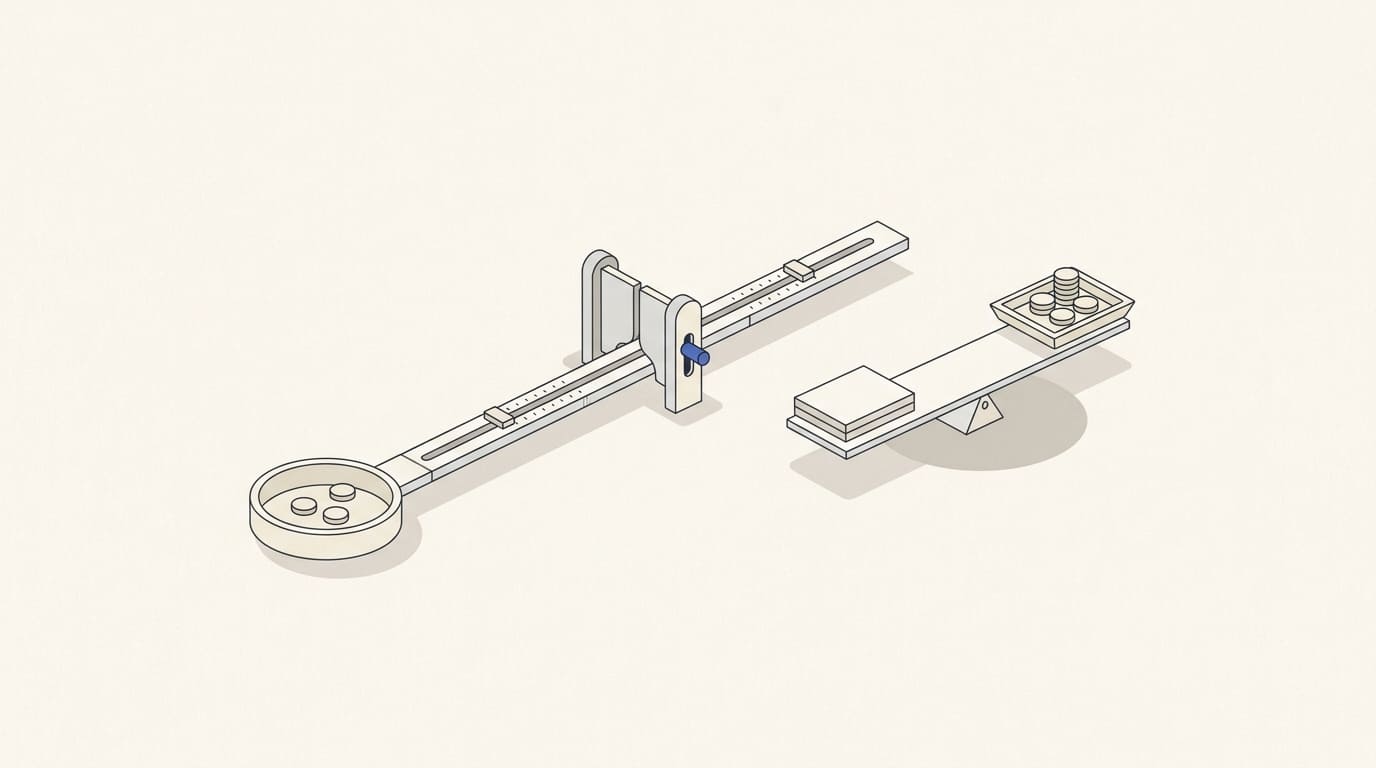
Advertising is bringing in customers, and the business is ready to invest more. Doubling the budget and expecting twice as many sales seems logical. Yet the next tranche of spending may acquire customers at a higher cost as available impressions, audience composition and pressure on the sales team change.
To keep budget growth manageable, assess the cost of additional customers and define the conditions for the next step in advance.
Calculate your acceptable acquisition cost
Start with the economics of an order. Deduct direct product or service delivery costs and other variable expenses from revenue. Decide how much of the remaining amount can fund acquisition while leaving enough for fixed costs and profit.
If you include repeat purchases, use verified customer history. Future orders that exist only as expectations should not justify a loss-making launch.
Separate two metrics:
- Customer cost based on media spend. Divide the advertising budget by the number of new customers acquired.
- Acquisition cost including additional expenses. Include the relevant costs of management, creatives, tools and sales. Define the cost categories so that comparisons use the same metric.
Do not mix new customers with repeat orders. We explain the differences in our article on ROAS, CPL and customer acquisition cost.
Check whether the current result can be assessed
Before increasing the budget, check that leads have been processed, sales have been linked to their sources and the data contains no duplicates. Allow for the delay between a click and a deal.
If the sales cycle takes several weeks, the latest week of spending does not yet show the full result. Compare lead cohorts that have had enough time to move through the same stages.
Also establish what drove the success: one large order, a seasonal promotion, branded demand or repeatable acquisition of new customers. One successful period is insufficient evidence for confident scaling.
Find the constraint on growth
A larger budget does not solve every problem. Check four areas:
- Demand and reach. Are there additional relevant searches or audiences the campaign can reach?
- Advertising. Has traffic quality deteriorated? Do the offer and creatives need refreshing?
- Website. Do forms, payments and pages work on mobile devices?
- Sales and delivery. Can the team handle more enquiries promptly and fulfil the orders?
If sales staff already struggle to respond, higher spending may increase losses. Remove the constraint first, then assess the next budget level.
To assess the workload, revisit the initial budget calculation based on clicks, leads and sales.
Change the budget with a clear hypothesis
Choose one campaign or activity with proven lead quality and viable economics. Record the baseline metrics, the size of the change and how much you are prepared to spend before reviewing it.
Avoid changing the budget, audience, offer and landing page simultaneously if you want to understand the effect of increased spending. When several changes are necessary, record them and assess the whole new scenario rather than attributing the result solely to the budget.
There is no universally safe percentage increase. The size of the step depends on data volume, campaign stability, bidding strategy and acceptable risk. A rule such as “always increase by 20%” cannot replace checking these conditions.
Hypothetical example: the average hides an expensive increase
Suppose a business spends €2,000 on media over a comparable period and acquires 10 new customers. The cost based on that spending is €200 per customer.
With a €3,000 budget, it acquires 13 customers. The average is approximately €231: €3,000 ÷ 13.
However, the additional €1,000 brings only three additional customers. The cost of that increase is approximately €333 per customer: €1,000 ÷ 3. If the business has set a €280 ceiling for this metric, the next budget increase needs reconsidering.
This is a hypothetical comparison, not proof of causation. In practice, account for changes in demand, deal timing and other channels. If creative or lead handling costs rose alongside the budget, include them in the appropriate calculation too.
Set rules for continuing and stopping
Before changing the budget, agree on:
- What counts as a new customer and which expenses are included.
- The cost the business is prepared to accept.
- The amount that can be spent before the next review.
- The time needed to process leads and allow them to mature.
- Signs requiring immediate action: broken tracking, a stream of unsuitable leads or spending above the agreed limit.
- The results that warrant maintaining, increasing or returning the budget to its previous level.
Monitor intermediate metrics too: cost per suitable lead, qualification and response speed. Base the final growth decision on business results once they become available.
What to do when the cost increases
First identify where the change happened. Have clicks become more expensive? Has website conversion dropped? Are different searches bringing people in? Are sales staff responding more slowly? Each cause calls for different action.
If you need a new advertising approach, use our creative testing plan. If you change bidding strategy, consider its objective and data requirements, covered in our article on choosing bids when sales data is limited.
When arranging advertising setup and management, agree on a budget growth plan together with review and stopping criteria. Discuss the scope of work using our commercial proposal.