
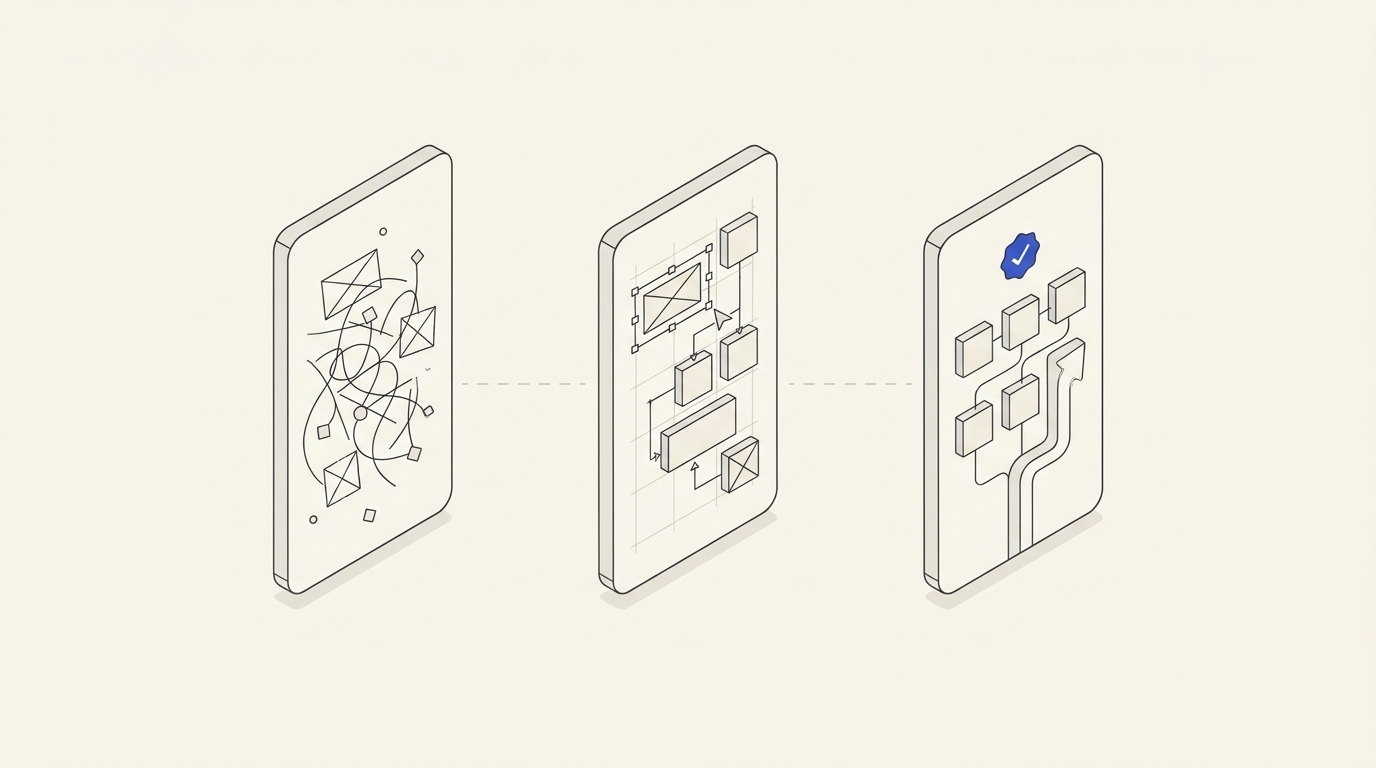
A short B2B video shows office workers, laptops and stylish editing but never explains what the customer receives for their money. For a complex service, that is insufficient. An effective Reel connects a recognisable client problem, a specific working action, a verifiable deliverable and a practical next step.
Define the service before the shoot
Identify the customer type, starting situation, responsibility boundaries and deliverable. An SEO audit may produce a prioritised issue map, not “number one on Google in seven days”. A website project may deliver working forms and a tested structure, not merely polished screenshots. No promises should exceed the approved project scope.
Show tangible work rather than generic activity
Useful footage may include a report excerpt, diagnostic sequence, prototype, form test or before/after comparison. If customer materials are confidential, make synthetic examples and do not present them as real cases. Reels production covers concepts and editing, while the service owner approves technical statements. A storyboard should specify which shot supports each claim and which evidence is safe to display. Check those proof points before the editing begins.
A short story has one main job
The first seconds establish the problem, the middle demonstrates one or two actions, and the ending makes the outcome and next step concrete. Do not compress a whole contract into 20 seconds; a sequence of separate videos can cover diagnosis, implementation and acceptance.
Initial TASK-095 outline
A fictional client requests an audit of website forms. The 20-second video uses synthetic interfaces: 0–4 seconds show a lead with missing source data; 4–13 seconds show comparison of two submissions and checking CRM field mapping; 13–20 seconds show an issue list, two validated test events and an invitation to send the website address. The finished shooting list below makes these approximate blocks exact.
Complete six-shot plan, 9:16, exactly 20 seconds
Fictional company F-095 uses a test site, sample enquiries F095-A and F095-B, two CRM card designs and an anonymised field map. These images demonstrate expected output, not a claimed completed client integration. Check readability on a real phone.
- 00:00–00:03, problem. Close view of synthetic F095-A with a blank source field. Overlay “A lead arrived—but from which page?” No real contact data.
- 00:03–00:06, comparison. Two sample forms on different test pages show the source distinction; do not promise higher sales.
- 00:06–00:10, investigation. Highlight test fields “page”, “service type”, “form ID” and their CRM mapping.
- 00:10–00:14, test action. Submit synthetic enquiries F095-A and F095-B. Hide tokens, API keys and customer contacts.
- 00:14–00:17, verifiable artefact. Two example CRM cards display distinct source values beside a short checklist. Label them as illustrations of the expected result.
- 00:17–00:20, next step. Show deliverables: data-transfer map, issue list and test protocol; invite the viewer to send a website URL for individual assessment.
Materials, permitted claims and confidentiality
The client supplies the form and lead-flow description, permission to film or use mockups, the data-field list, approved claims, CTA and decision-maker. The producer supplies the timed storyboard, synthetic-screen list, edit draft, subtitle plan and claim-check list. If the integration is not yet live, an example of success must be labelled as a proposed state. It is not a real project recording.
It is acceptable to say an audit identifies a missing field and prepares a correction plan; without evidence do not claim universal deployment, a 40% conversion increase or zero future errors. Keep real names, authentication details and secrets out of footage, editing files and previews.
Acceptance checklist for TASK-095
- Confirm 3+3+4+4+3+3 = 20 seconds with every planned shot present.
- On a phone without sound, the problem, data route, expected result and CTA remain clear; subtitles avoid platform controls.
- All IDs are synthetic and no real personal data or system access details appear.
- Each concrete statement matches an approved service scope; no synthetic CRM screen is called a completed client case.
- Positive: the viewer can name what is checked and which document is delivered. Negative: only vague “automation” footage remains, without source fields or report.
Commissioning and editing
Agree shots, captions, safe zones, usage rights, voice-over and final CTA. Offer strategy helps define one clear message for the intended buyer. Through contacts, supply actual service materials, filming restrictions and distribution channels. The published Reels production offer describes package production; a specialised technical storyboard and screen recording needs explicit scope rather than presumed inclusion.
A service Reels scripting guide connects the opening question, factual proof and next step. When the service is filmed at a real workplace, location preparation helps verify sound, privacy and permitted actions. The published production offer concerns content production; a specialist B2B demonstration and technical review still require their own scope.