
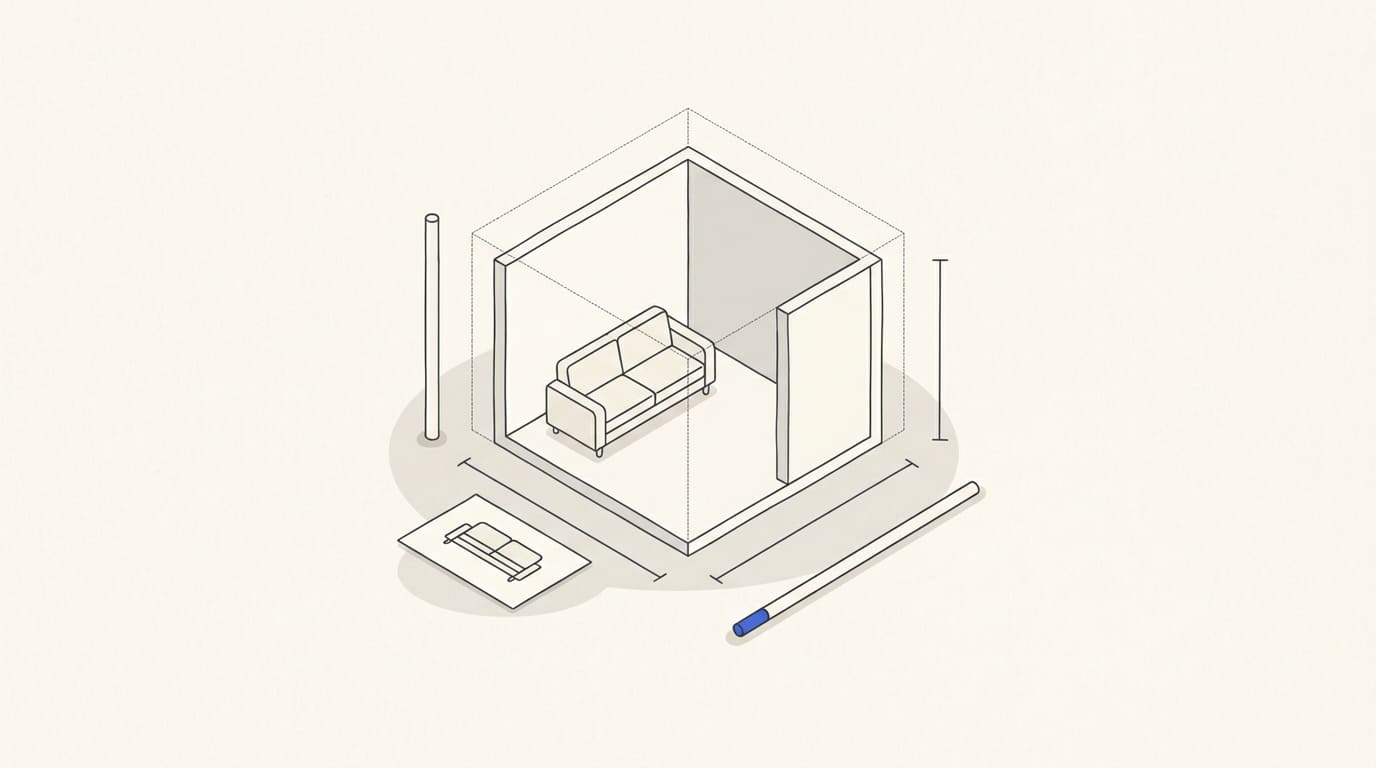
A sofa looks impressive in a generated room, but has become narrower, its legs have changed and the nearby walkway appears wider than it could be. The scene conveys atmosphere but does little to assess the actual model.
Furniture visualisation requires separate control of the product and surroundings. Dimensions come from confirmed data, appearance from product references, and the interior is assessed against the image's purpose.
Define what the image should demonstrate
Clarify the task: showing furniture in an advertising scene, comparing finishes or placing it in a specific room. Each needs different inputs and checks.
An image of a model being sold should preserve its shape, construction and available configuration. Do not present a generated interior as a completed project or installation photograph.
An AI interior concept can explore atmosphere. Checking whether furniture fits requires measurements and a placement plan; an impression from an image does not replace calculation.
Prepare dimensions and product references
Provide width, height and depth with units and measurement points. For convertible furniture, include dimensions in use; for modular items, specify the configuration.
Collect several views of the exact model and details such as legs, arms, seams, handles and material patterns. Identify colours and finishes belonging to the selected variant.
If a hidden side is not documented, do not expect generation to reconstruct it accurately from one photograph. Input preparation is covered in materials for product visualisation.
Agree the viewpoint and scene scale
The product photograph and scene should have compatible camera positions and perspective. A major viewpoint change may need another photograph or a verified 3D model rather than deformation of the original.
For a specific room, provide real wall, opening and placement dimensions. Generated objects are not reliable rulers: their own scale may be wrong.
Illustrative example. Measurements give a sofa width of 220 cm and a wall section of 250 cm. The difference is 30 cm in total, not 30 cm on each side. The image should be compatible with these figures, but does not confirm walkway access, door opening or ease of use.
Do not infer real dimensions from pixel ratios of objects at different distances from the camera.
Preserve the product when changing surroundings
When using a product photograph, separate it from the generated background and control changes to the object. See AI backgrounds for product photographs for the approach.
Check floor contact, shadows, lighting direction and reflections. They support credibility but should not obscure construction details or alter the perceived finish.
Strong colour grading can change the apparent fabric or wood. If shade affects selection, retain a verified finish image and explain that the interior scene does not replace a material sample.
Check the final file against product features
Compare silhouette, part count, proportions, seams, fastenings and material pattern with the references. Review the full image and enlarged areas separately.
Check crops as well as the main file: a narrow format can hide legs, construction or variant information. Keep source files and the approved version for later adaptations.
Clearly identify the visualisation's status where it affects understanding. Do not accompany a concept scene with a claim that the furniture has already been installed in that room.
An interior furniture acceptance checklist
- Model, configuration and image purpose are identified.
- Dimensions are confirmed and have clear units.
- References cover visible sides and important details.
- Product viewpoint matches the scene's perspective.
- Scale is not justified solely by generated surrounding objects.
- Shape, finish and construction match the selected product.
- Shadows, crops and publication status are checked.
For AI product visualisation, provide photographs, dimensions and the scene's purpose. These support agreement on method and acceptance criteria; verify placement in the actual room separately through measurements.