
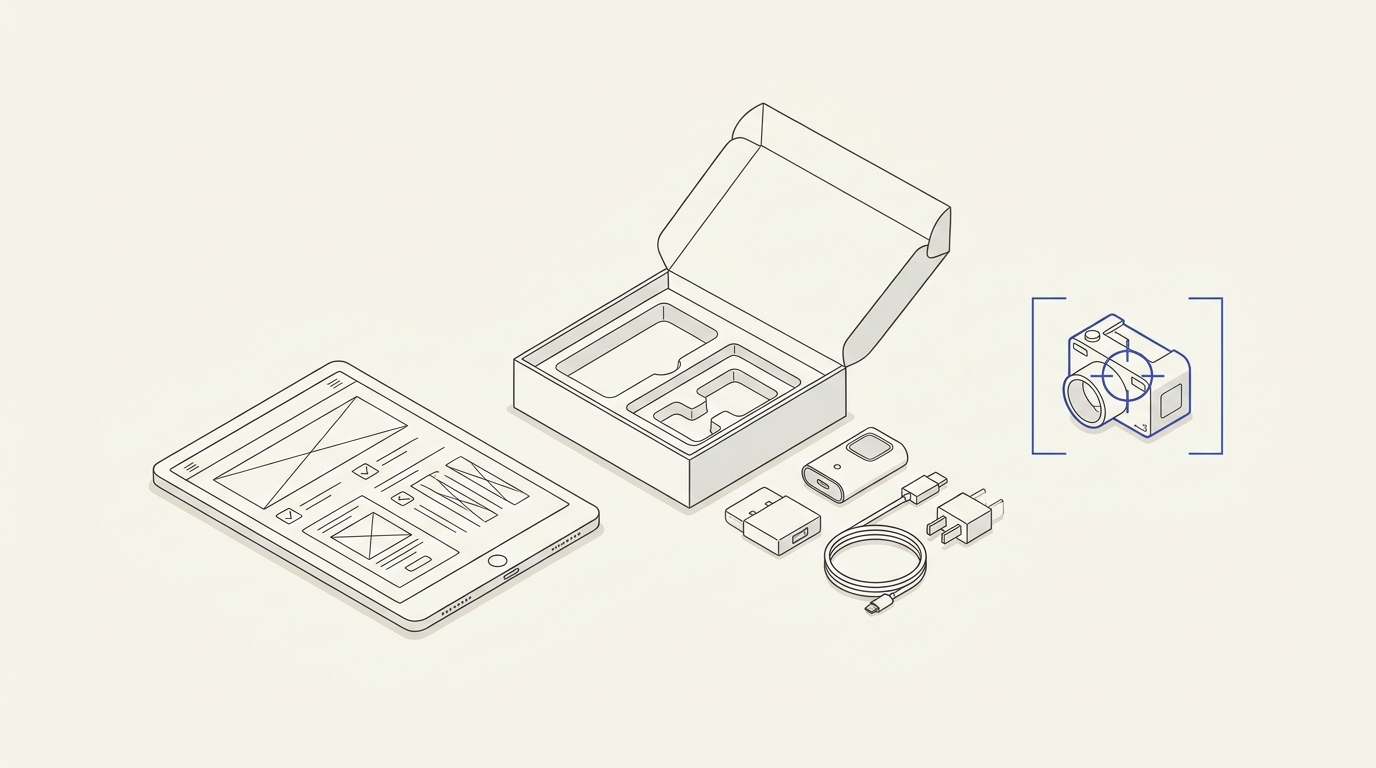
An attractive AI product mockup is not necessarily an accurate picture of what a customer will receive. A generator may invent a port, change the number of controls, add an accessory or draw an internal detail incorrectly. That creates commercial risk: buyers may expect unavailable items and the business may face costly ad changes and complaints. Accept AI product visuals for factual accuracy separately from their artistic quality.
Establish a verified product reference before generation
Collect current photographs of the actual product, approved specifications, everything included in the box, materials, colours, dimensions, use restrictions and examples of prohibited imagery. Separate decorative, hypothetical scene elements from details customers may interpret as a factual claim. If precise information is unavailable, do not ask a model to invent missing features.
The published product preparation guide for AI visualisation describes photographs, approved labels, SKU variants and packaging details. It is a starting point for acceptance checks, not proof that a particular generation is correct. The RU article additionally references detailed posts about SKU kit composition and product colours; do not infer unpublished EN equivalents from those addresses.
Distinguish product properties from decoration
Changing the background, atmosphere or product position may be acceptable. Changing shape, markings, connections, contents or relative size may be misleading. Regulated goods and technical performance claims require review by a competent product specialist. Generative software is not a source of technical truth.
AI visual content production can develop scenes and compositions, but the product owner must approve factual details. A generated image must not be presented as a documentary photograph when the depicted features are not confirmed.
Worked hypothetical TASK-089: incorrect kit contents
Set KIT-089 contains one device housing, one charger and two mounting elements. A generated ad scene adds an extra cable that is not included. The lighting and background are attractive, but it must not be published as a visual inventory of the box.
- Approve a reference list: one housing, one charger and two fasteners.
- Compare every visible part with the catalogue and real technical photographs.
- Flag missing, extra or distorted components and physically impossible connections.
- Correct or regenerate the scene, then repeat the item-by-item check.
- Obtain approval from the product owner and preserve the final version identifier.
Positive test: all four required pieces are accurately presented, no additional accessories appear and the image does not mislead. Negative test: a regenerated image invents a third cable or changes the fastener count again. Reject it regardless of aesthetics.
Review each publishing channel separately
Accuracy is especially important for product listing images. Concept advertising may include artistic elements as long as these do not imply false features or contents. Check the current marketplace and advertising platform policies for the country and category. Do not assume all AI imagery is automatically permitted in every placement.
Trace acceptance back to the product record
Without an approved description, nobody can prove an accessory was invented, a finish changed or a label became inaccurate. Link each disputed detail to the SKU, source photograph, brief requirement and output frame; do not replace factual checks with an overall aesthetic impression. Keep a change log naming who signed off actual product characteristics.
Define production scope
Source-reference count, product variants, detail complexity, output sizes, retouching and review rounds affect the estimate. Send full product photographs and specifications through the published graphic-design offer as commercial context and agency contacts for a specific request. The published offer permits AI-driven creative design but is not a guarantee of complete SKU accuracy or a replacement for product photography and item inspection.
An independent kit specification
Fictional shop V-89 sells lamp L-89 in two variants. Basic includes a housing and mounting part; premium additionally includes a shade. A generator cannot infer which boxed set is sold from promotional copy alone. Sign off SKU names, included components, dimensions, material, allowed camera angles and prohibited objects before creating any imagery. A sample image can show shape, but it is not necessarily the current packing list.
- Associate SKU L89-B with two pieces and L89-P with three. These codes are synthetic.
- For each file record its revision, the corresponding variant and source evidence.
- Inspect count, fit, colour, markings, mounting, scale and background suitability separately from aesthetics.
- Have a product reviewer log factual defects; the designer repairs the scene and resubmits it.
Completed acceptance example for TASK-089
Image “L89-B, revision 01” mistakenly shows the extra shade. Compared with L89-B, that is an extra item; reject the image despite beautiful lighting. Revision 02 omits the shade but also does not show the mount. It might be acceptable as an atmospheric ad with an explicit understanding that the full kit is not depicted, but not as an exhaustive “in the box” graphic. That requires another approved view showing both basic components. Positive test: SKU, kit and intended image use align. Negative test: the premium configuration is presented as basic. A generated file alone is not evidence of what the purchaser receives.
When the approved product depiction is used in a campaign, digital and offline banner production is an adjacent design task. It does not replace SKU-level verification of what is actually included in the purchase.