
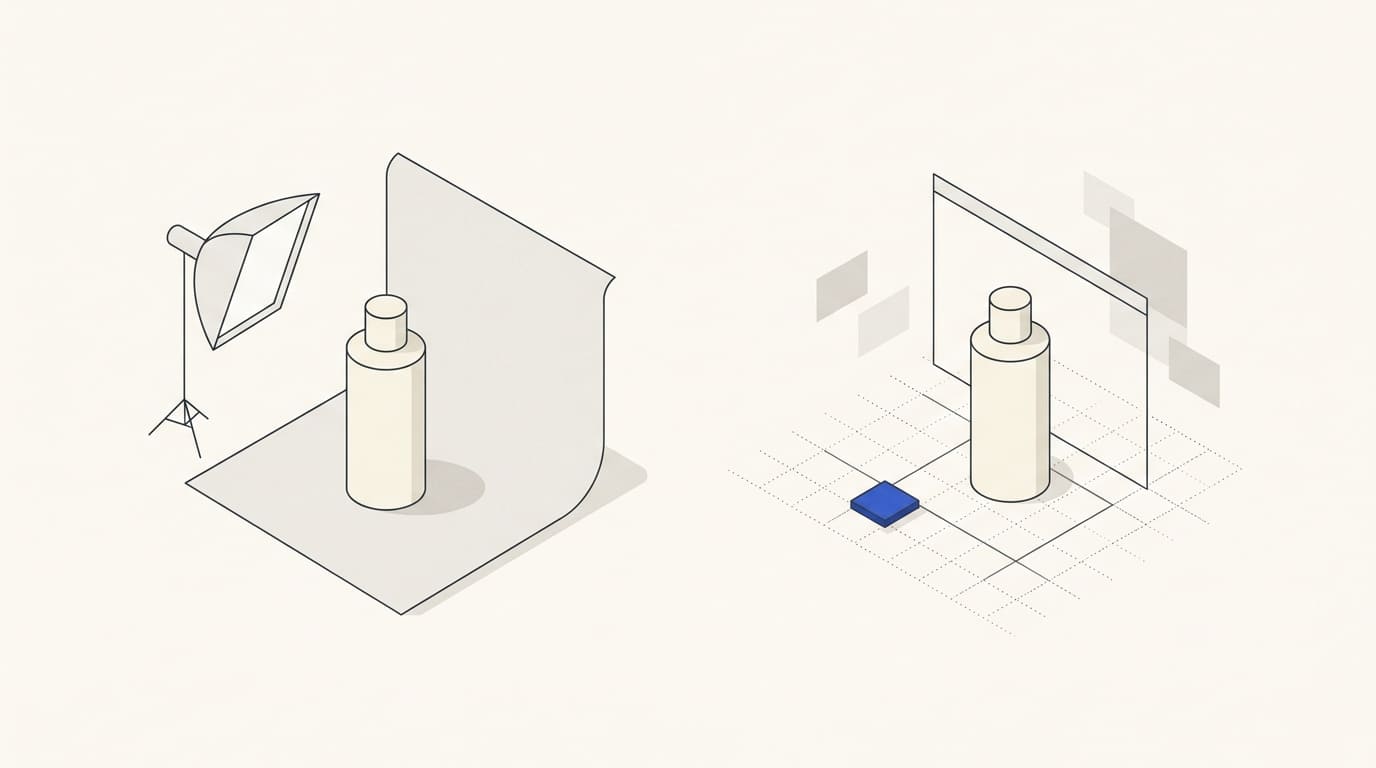
A product image helps customers understand what they will receive. A catalogue needs accuracy and visible details. Advertising also needs context, composition and a presentation that explains the offer.
Product photography and AI visualisation can address different parts of this task. The choice depends on which product features you need to show, how many materials are required and how you will verify the result.
Separate catalogue and advertising needs
Catalogue images should help customers assess a specific product: its shape, colour, material, contents, labelling and available variants. Customers may need several angles and separate detail photographs.
Advertising images can show the product in use, in an interior or in another appropriate setting. Maintain an accurate representation of the product and clearly distinguish it from scene elements that are not included in the purchase.
Concept visualisation helps discuss an idea for a future product or design. If an image shows a version that does not yet exist, identify it as a concept. For a live product listing, use materials that match the version being sold.
When is product photography especially useful?
Photographing a real sample helps show the features that influence the choice:
- the texture of fabric, wood, metal or another material;
- transparency, shine, seams and small components;
- markings and labels;
- the exact contents of the package;
- differences between actual product variants;
- fit or interaction with the product in use.
Photography also requires checks: lighting, retouching and screen colour reproduction can alter perception. Before the shoot, agree on the required angles, details and permissible editing.
For an ongoing catalogue, document the lighting, background, scale and camera position. This helps maintain a consistent appearance as new products are added.
When can AI visualisation be useful?
AI can help develop different settings, advertising scenes and visual concepts. You can combine it with product photographs, preparing the background and composition separately.
With this approach, the original product can remain on a separate layer. If generative editing affects the product itself, compare every result with the real sample: proportions, text, details, materials or the logo may change.
A large number of generated variants does not mean a large number of images ready to publish. Include selection, checking and corrections in the work plan.
We use product photographs, labels, logos and other source materials in our AI visual content and product visualisation service. The appropriate workflow depends on the objective and the required product accuracy.
Comparing the approaches
AI does not always reduce the budget. If a product is complex and every image needs extensive correction, assess the benefits against the cost of an approved result.
How to calculate the budget
Compare proposals using this formula:
Preparation + creation of source materials + photography or generation + editing + checking + adaptations.
Clarify the number of products, angles and final images. Ten products with three angles each mean thirty product images. Account for advertising scenes and format adaptations according to a separate list.
The proposal should make clear:
- What the client provides before work starts.
- How many finished images the client receives.
- Which changes and revisions are included.
- Who checks that the image matches the actual product.
- Which sizes, formats and source files are delivered.
- How additional products, scenes and adaptations are priced.
What to check before publishing
- The shape and proportions match the product.
- The colour, material and texture are represented accurately.
- Labels, the logo and text are not distorted.
- The package contents are clear, and decorative scene elements do not create misleading expectations.
- The image matches the selected product variant.
- The background and editing do not conceal important details.
- The file meets the requirements of the intended placement channel.
For Google Merchant Center, check product image requirements separately from advertising layouts. Google requires a clean view of the product for sale without promotional overlays and recommends showing the matching product variant. Merchant Center image requirements.
Google also permits images created using generative AI and requires metadata indicating how they were created to be retained. The IPTC DigitalSourceType property with an appropriate value is used for this purpose. Check that the required metadata survives export and compression. A text label on the page does not replace it. Google's requirements for AI-generated content.
These requirements apply to Merchant Center. Check other platforms' own rules before uploading materials.
A hypothetical example of choosing an approach
Suppose a company sells bags in several colours. Its catalogue needs actual images of each variant, the fastening, the interior and the material's texture.
For advertising, it can use a verified image of the bag in different scenes prepared with AI. Compare the final bag with the original and check that the setting does not misrepresent its size or use.
If a new angle is needed and is missing from the source images, consider additional photography. An AI version should only be considered after checking the accuracy of every significant detail.
This hypothetical example illustrates how tasks can be divided between the approaches.
How to choose a workflow
Start with a list of images and the features they need to show. Try the approach on a small agreed set of materials, then assess accuracy, correction time and the cost of the finished result.
If you then need ads with text, an offer and size adaptations, these can be prepared through our advertising banner and creative design service. Include product images and advertising layouts as separate deliverables in the brief.
It is easier to choose an approach by looking at specific materials: which images require a real sample to be photographed, where an AI scene is appropriate and how the team will verify accuracy before publication.